a = np.array([-1,3, 2, 6])
b = np.array([3,6,1,2])

A = a.reshape([2,2])
print(A)
print(f"A.ndim:{A.ndim}") # 2차원
print(f"A.shape:{A.shape}") #2,2

B = np.reshape(b,[2,2])
print(B)

print(f"A+B\n:{A+B}")
print(f"A*B\n:{A*B}")
print(f"np.matmul:\n{np.matmul(A,B)}")
A B
[[-1 3] [[3 6]
[ 2 6]] [1 2]]A+B
:[[2 9]
[3 8]]
A*B
:[[-3 18]
[ 2 12]]
np.matmul:
[[ 0 0]
[12 24]]# matmul
결과 행렬 AB = A × B
각 원소의 계산 과정:
AB[0][0] = A[0][0]*B[0][0] + A[0][1]*B[1][0] = (-1)*3 + (3)*1 = 0
AB[0][1] = A[0][0]*B[0][1] + A[0][1]*B[1][1] = (-1)*6 + (3)*2 = 0
AB[1][0] = A[1][0]*B[0][0] + A[1][1]*B[1][0] = (2)*3 + (6)*1 = 12
AB[1][1] = A[1][0]*B[0][1] + A[1][1]*B[1][1] = (2)*6 + (6)*2 = 24

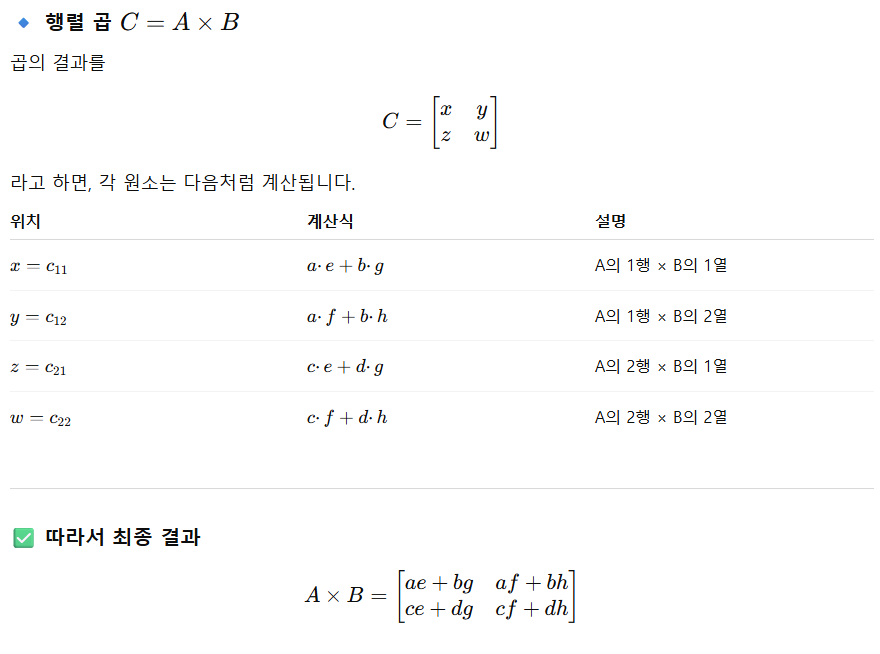
👉 왼쪽은 e, g (B의 왼쪽 세로줄),
👉 오른쪽은 f, h (B의 오른쪽 세로줄) 과 곱하면 됩니다.
'Data & AI Intelligence > ▶Preprocessing & EDA' 카테고리의 다른 글
| 데이터 클리닝(정확성) (0) | 2024.06.04 |
|---|---|
| 데이터 클리닝(유일성) (0) | 2024.06.04 |
| 데이터 클리닝(완결성) (0) | 2024.06.04 |
| 데이터 정제 (0) | 2024.06.04 |
| Pandas 기초: 데이터 타입 확인 및 외부 CSV 데이터 로드 (0) | 2024.06.03 |


